9TimeZones.com
is: Anikó J. Bartos
and: Alan C. Baird
Scripts: Vlad\
Côte d'Azur\
Fall In Budapest\
Merlinsky\iSex\
Eleven Thousand
Virgins\Azért is..!now \ then:
'26:jfmamjjasond '25:jfmamjjasond
'24:jfmamjjasond
'23:jfmamjjasond
'22:jfmamjjasond
'21:jfmamjjasond
'20:jfmamjjasond
'19:jfmamjjasond
'18:jfmamjjasond
'17:jfmamjjasond
'16:jfmamjjasond
'15:jfmamjjasond
'14:jfmamjjasond
'13:jfmamjjasond
'12:jfmamjjasond
'11:jfmamjjasond
'10:jfmamjjasond
'09:jfmamjjasond
'08:jfmamjjasond
'07:jfmamjjasond
'06:jfmamjjasond
'05:jfmamjjasond
'04: fmamjjasond
1996apr 2001sep
»» moblog:
is: Anikó J. Bartos
and: Alan C. Baird
Scripts: Vlad\
Côte d'Azur\
Fall In Budapest\
Merlinsky\iSex\
Eleven Thousand
Virgins\Azért is..!now \ then:
'26:jfmamjjasond '25:jfmamjjasond
'24:jfmamjjasond
'23:jfmamjjasond
'22:jfmamjjasond
'21:jfmamjjasond
'20:jfmamjjasond
'19:jfmamjjasond
'18:jfmamjjasond
'17:jfmamjjasond
'16:jfmamjjasond
'15:jfmamjjasond
'14:jfmamjjasond
'13:jfmamjjasond
'12:jfmamjjasond
'11:jfmamjjasond
'10:jfmamjjasond
'09:jfmamjjasond
'08:jfmamjjasond
'07:jfmamjjasond
'06:jfmamjjasond
'05:jfmamjjasond
'04: fmamjjasond
1996apr
»» moblog:
Summer of '91.
 Personal Ad: "I love sexy, literate men. Could you be my Cyrano?"
Me: "Maybe. But I'll have to brush up on my swordplay."
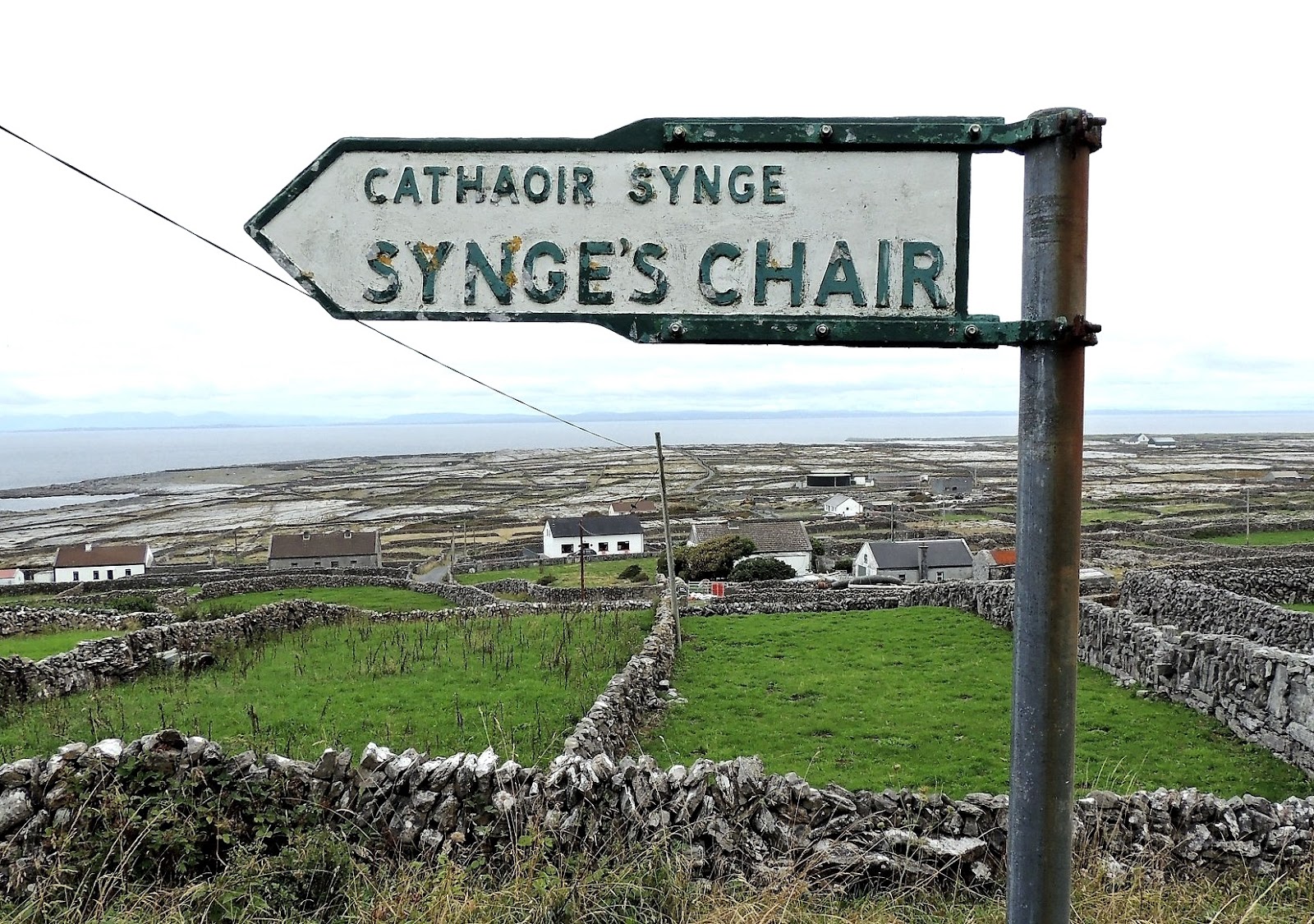
Cathaoir Synge
It was the fourth day of our Irish holiday, and I was feeling wistful, because we had both come to know that the trip would mark the end of a romance which had been shaky at best.
Colleen was an Irish-American professor of theater, and she had wanted to show me all of her favorite spots in the Gaeltacht, an Irish-language region of the Emerald Isle. One of the places she loved was Inis Meáin, in the middle of the Aran Islands, a small group just off the western coast. Connoisseurs of fine woolen knitted sweaters would know of the area, perhaps preventing its descent into total obscurity.
Getting to this out-of-the-way locale was a bit of a chore - the ferry landed there only on certain days, since it was so far off the beaten track, and the trip included a lengthy stop at another island along the way. While waiting for the tide to advance to the point where it would be possible to dock at our island, we strolled hand-in-hand during the layover at Inis Oirr. It proved to be a bittersweet interlude - there was no use in discussing the end of something we both knew was dead, but we decided to make the best of our month-long journey together.
As we waited for the first mate to ready the small ferryboat for the next part of the voyage, it soon became apparent to both of us that the poor man had not been blessed with good looks. His hunchback, his immense hooked nose, and his manner in scuttling about the boat all reminded us of a certain horror movie. We simultaneously turned to each other, whispered "Igor!" - and shared a much-needed laugh.
The final leg of our trip was stormy and wind-tossed, as if to confirm the Gothic mood suggested by Igor's appearance. I knew we were going to a place where the twentieth century had made very few inroads, and the sense of isolation sharpened as Colleen slowly became seasick. After struggling against it for several minutes in the tiny cabin, she went out on deck to brave the high seas and christen the waves with the remains of her breakfast.
The captain was unsure whether conditions would allow a safe landing on our island, and indeed the docking was a bit dicey - we were the only two passengers to disembark, and the wind rocked the ferry alarmingly. They practically had to throw us up onto the cement pier, and our knapsacks were heaved up after us. We dusted ourselves off and leaned vigorously into the wind. After struggling past some rotting fish remains, we entered a narrow, paved path lined with six- and seven-foot walls of masterfully interlocked stones. We couldn't hear each other speak, but Colleen pointed up ahead, in the general direction of our destination. Through a small crack in the wall on our left, we could see the ruins of a tenth-century church, and I got the unsettling feeling that we had traveled far back in time.
A huge, slobbering canine charged from our right, and I think we both screamed, but an old crone with a toothless grin made motions that the dog was only being friendly. As we all continued to walk between the walls of stone, the wind quieted somewhat, and Colleen made an attempt to converse with the woman. Even though I was next to her, I couldn't hear a word, but it appeared that this dog owner was simply promenading her beast around the perimeter of the island, in what I judged to be near-hurricane conditions. We came to several paved cross-paths, all lined with the walls of stone, and Colleen indicated that we should turn and part ways with the old woman. We all waved goodbye, and I briefly wondered how anyone could find their way around in this confusing maze.
After some hot soup at the bed-and-breakfast cottage (which magically appeared out of nowhere), the wind calmed down and the weather even turned sunny. Colleen and I ventured forth, walking toward the hill of our small island, and she explained the stone walls. Many centuries ago, the place was covered only with rocks, but the first settlers were determined to make soil where none had existed before. So they dragged seaweed out of their fishing nets, carefully placing walls of the all-too-plentiful stones around it, and left it to rot in the intermittent sunshine. Over the course of many years, the fences of stone, crucial for keeping the newly-formed compost from blowing away in the constant windstorms, were extended to form a continuous crosshatch of tiny pastures all over the island. Most of the fields were not much larger than a small house, and the crazy patchwork was broken at irregular intervals with paths connecting various areas. Sheep and other farm animals were ferried in, and an agrarian/fishing culture clung tenaciously to life on this tiny outpost.
Daily life was harsh, and most of their young folk were leaving for the excitement of cities on the mainland or in America, but the ones who remained were amazingly tough and taciturn. They drank silently in the island's one pub, and very infrequently they would sing, if the hour got late enough, and the Guinness held out. Their voices were heartbreakingly beautiful, crooning the ancient songs in the ancient tongue.
Today, Colleen and I were headed toward the far end of the island, where the famous Irish playwright John Millington Synge ("Playboy of the Western World") often withdrew to write. He had a summer residence on Inis Meáin at the turn of the century, to escape the pressures of civilization on the mainland, and his sojourns were proudly documented with several Irish-language signs. One pointed the way to his thatched-roof cottage; another, down the path leading to his favorite writing retreat.
During our walk, Colleen regaled me with stories of her last stay - after one late-night songfest in the pub, she said she found herself face to face with the ghost of Synge, near dawn at the entrance to his old cottage. She was a very down-to-earth and practical woman, and she couldn't logically explain her certainty that she had been in the presence of the great man himself. This streak of mysticism in an otherwise severely rational academic was suddenly appealing, and I suggested that we climb a few rock fences to find a deserted field.
The denizens of the island had become experts in stonemasonry over the millennia, and had built unobtrusive step-stones into the sides of the walls. These steps led up to small notches that a person could fit through, but which would foil any escape attempt by the sheep. After crossing several notches, we found ourselves at the open entrance to a tiny field-inside-a-field. Evidently there had been too many rocks remaining when the farmer had finished his outer wall, so he had erected a smaller inner enclosure, just to clear the area of leftover stones.
No-one was visible for at least a mile, and we were delighted with our own little private "fort," so we ogled each other hungrily as we quickly shed our clothes. But afterward, the flattened wildflowers seemed unbearably melancholy. We dressed while studiously avoiding each other's eyes, and slipped quietly away from the ground we had desecrated.
A few minutes later, we arrived at the end of the path which announced "Cathaoir Synge." It was anticlimactic - a semi-igloo of stones had been erected at the top of a promontory facing across to the outer island of Inis Mór. When Colleen crawled inside Synge's "chair" to steep herself in meditation on the playwright, I climbed a little way further down the cliff and watched the seagulls soaring above the crashing waves two hundred feet below.
I became lost in a cheerless reverie, and didn't notice one gull, inching closer and closer in her weaving flight path across the cliff, until she was almost in my face. I threw my hands up automatically - the bird stalled dead in midair, and wheeled away, startled enough for the two of us. I kept an eye on her, and after a few minutes she was back, at a more comfortable distance. I extended my hands again, partly to reassure myself and to make light of my earlier shock. She executed the same stall-and-wheel maneuver. When she returned a third time, we each played our parts again, and I began to suspect that I might be too near an egg-filled nest which she was protecting. So I backed off to the top of the cliff, but the gull followed...
As I walked from one side of the bluff to the other, it became obvious that I was drawing her away from the comfortable soaring of the windy updrafts into a relatively calm area behind the crest. She was working harder to fly, trying to continue the game we had started, and I gradually realized that I wasn't threatening her nest - she just wanted to play! To test this, I climbed back down to my original position on the cliff, and she moved a little further away, unconcerned. If anything, it seemed as if she was grateful that I had moved back into the updrafts, where it was somewhat easier for her to stay aloft. She lined herself up for another approach, I threw my hands skyward at the appropriate moment, and she stalled and wheeled. She was just a few feet away - close enough so I could see the energy she was investing to play the game. She exerted twice the effort of the other seagulls, who were lazily banking and circling as the wind took them. But she seemed to enjoy it, and I was having a grand time participating in a simple entertainment which this member of another species was generously bestowing upon me.
We continued for twenty or thirty minutes, until I became aware that Colleen was snapping pictures of us from the Cathaoir. I smiled up at her, she smiled at me, and our sadness was mended. I climbed back to the top, took Colleen's hand, and returned to the path, with the seagull drifting close behind. As we walked, I apologized to the gull for ending our game, and earnestly explained why she couldn't follow us back home. Colleen gifted us both with gales of laughter. [first publication in Dublin] [Substack]
 Ring of Kerry, Dingle Peninsula:
Behold a typical scene in an ambitious campaign to infiltrate the secret pub culture of western Ireland (native rituals dictate inhaling vast quantities of a thick brownish health shake). In the Gaeltacht, we find our hero reeling from the doorway of a local establishment, out like a carp.
Dan Foley's Pub, Main Street, Annascaul, County Kerry ~ street view ~ postcard
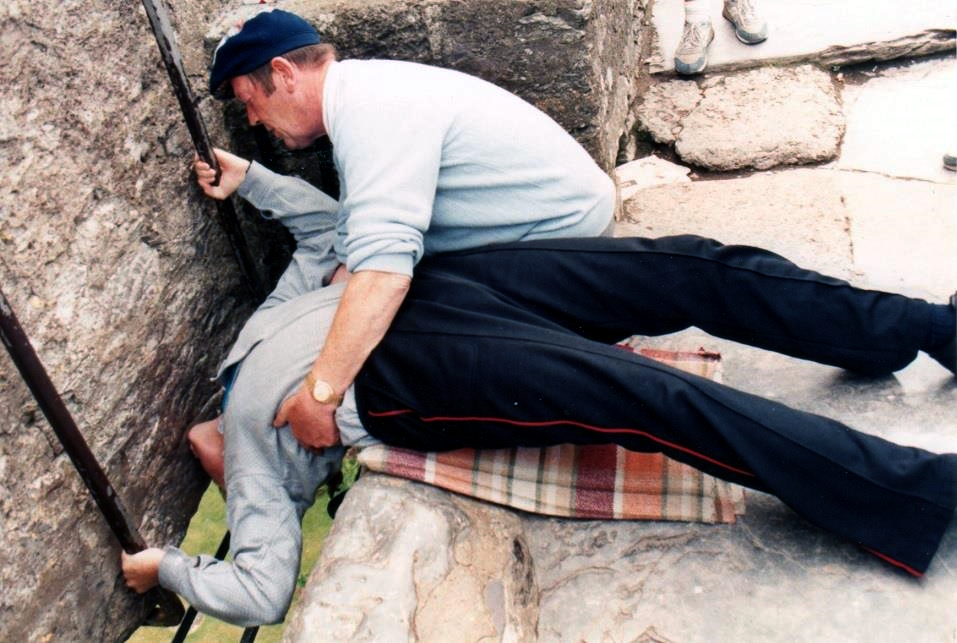 The Blarney Stone...
...is 90 feet above the ground, embedded in the outside of a crumbling parapet at the top of Blarney Castle, which dates from 1446. You must climb several decrepit spiral staircases in order to kiss the ancient bluestone. You lie down and arch your back over the edge while a guard keeps you from falling. You grab onto two iron rails to provide some relief from the vertigo, and as you look up at the ground from your upside-down position, you briefly wonder if there's any truth to the rumors that the guards piss on the stone at night, after the tourists go home. But you kiss the stone anyway, because (1) you've traveled such a long way, and (2) it will hopefully result in an interesting photo, and (3) your friends will enjoy making fun of you for kissing a piss-drenched rock.
The Blowup In Amsterdam
Colleen and I covered lots of ground in Ireland: on her birthday, I wrote our names in the sand at Inch Strand, after giving her a watch she'd always wanted (which I set to Irish time when buying it in L.A.). Then we swam with Fungie, the Dingle Dolphin, we crawled into the 5,200-year-old passage tomb at Newgrange, we visited William Butler Yeats' summer home in the 15th-century castle at Thoor Ballylee, and we admired the Autograph Tree (Yeats, Synge, George Bernard Shaw, Seán O’Casey and others) at Coole Park.
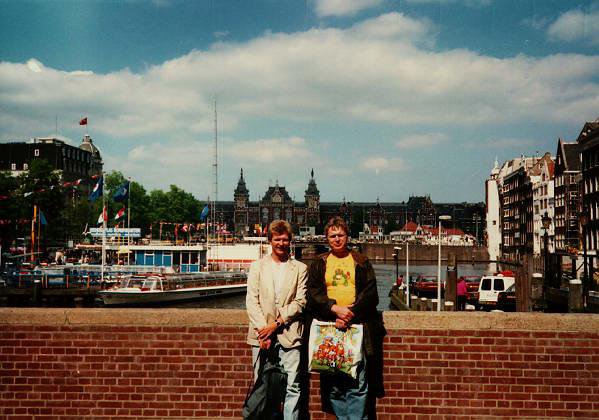
But things really got out of hand when we made a side trip across the Channel to Holland. Colleen was giving a paper at an academic conference, and I was helping her edit it. We invited my old Danish buddy, Jørgen, to join us in Amsterdam. Sparky and I had made some powerful memories a decade earlier in southern France, and we were eager to have fun in Amsterdam. But our ideas of a good time (touring the Heineken brewery and attending a concert by Al Di Meola) clashed dramatically with Colleen's ideas. So Sparky and I had our fun, and Colleen tried to punish us the next day. Luckily, the return flight to America was scheduled for that week, because Amsterdam really confirmed that a breakup with Colleen was best for the mental health of both of us.
Sparky and I, however, are friends to this day. 😉
Labels: hb
26 mi, 385 yd = 42.195 km.
 During 1976-1977, I was working as a bartender at Boston's Faneuil Hall and living in a crappy one-room cellar apartment on the unfashionable backside of Beacon Hill. The room came equipped with hot-and-cold running cockroaches and no windows, but it was all I could afford, back in those days. Plus, I was saving money to open a teeshirt business on the Côte d'Azur. But that's another story.
In the fall, I prepared for the 1976 NYC Marathon by working out at the Charles River Esplanade. It was a lovely run through the grassy park, looking across the river at Harvard, MIT and Cambridge, while watching the sailboats and rowing shells. After a reasonably-decent finish in October's New York race (761st/2090 starters in 3:28:01 for my first marathon, click images to enlarge), I continued working out, to prepare for the Boston Marathon in April.
 When the snow arrived, it became harder to run on the paths of the Esplanade, so after the Charles froze over, I continued training on the ice of the river. It was also a special experience, in its own way, but the flat course couldn't really prepare me for what was to come.
Boston Marathon, 18 April 1977: My quadriceps still remember Heartbreak Hill, 42 years later. The five miles of the Newton Hills came at the 16-mile mark, just as I was hitting the wall. The results were not pretty. I finished, but just barely (4:XX:XX).
Two years after I ran Boston, I watched my cousin Dave run it. He posted a much better time, but we had one experience in common. On the day following the race, I noticed that he paused at the top of a three-step stairway. Heartbreak Hill had done a tune on his quads too, so he slowly turned around, and walked BACKWARDS down the three steps.
I laughed like a hyena, and he nearly punched me. 😉
 Back to the NYC Marathon, 24 October 1976: (Poster Boy - "Over 2,000 Runners Crossing The Verrazano-Narrows Bridge") The first New York City Marathon, in 1970, had 55 finishers who completed several loops inside Central Park.
In 1976, to celebrate the U.S. bicentennial, the marathon moved outside the park for the first time, to run through the city's five boroughs: Staten Island, Brooklyn, Queens, the Bronx, and Manhattan.
2090 of us started on the upper deck at the Staten Island end of the Verrazano-Narrows Bridge. It was the world's longest suspension bridge span at that time, measuring 4,260 feet.
News choppers were hovering everywhere. A few of them took some interesting photos, like this one. If you click the poster to see a larger version, you'll notice another helicopter in the upper right corner. It's hard to imagine just how steep that hill into Brooklyn really is, until you run those 4,260 feet (1.3 km, 0.8 mi) on the roadway itself.
It was my first marathon, so I kept to the left edge of the pack, about halfway back from the leaders. I was wearing a yellowish teeshirt and maroon shorts, and there's only one guy with that color combo on the railing in that poster. So I stuck a red arrow on the glass, as a reminder.
So sue me.
Bill Rogers won in 2:10:10. I finished about 80 minutes later.
Below, left: me in Brooklyn, 1976, just before I lost the will to live.
Below right: me & Jørgen Stærmose at the WTC, 1980. See "The Day The Planes Stopped Flying."


NYC Postscript, 28 October 1978: I was living at the West Side YMCA in New York City when the 1978 marathon rolled around. It was just after my year of failing miserably at a teeshirts-to-the-tourists venture in southern France, and just before my six months of failing miserably at driving a taxicab on the mean streets of Manhattan. I wanted to get a different perspective on the dramatic marathon start at the Verrazano-Narrows Bridge, so I hopped a bus for Staten Island on the morning of the race. The bus got nearly halfway across the bridge on the lower deck before the inevitable traffic jam, but I somehow talked the driver into letting me out onto the roadway. I still can't believe he agreed to do it. Do you remember that heart-stopping scene in Saturday Night Fever, when John Travolta and his friends climbed into the superstructure of the bridge? That was my route to the top deck. When I finally vaulted over the guardrail onto the roadway, both sides were clear... so I jogged up to the top of the hill at the middle of the bridge and looked down at the runners, waiting for the starting gun. They would be running on the south roadway, so as long as I stayed on the north side, I wouldn't be in anyone's way. Motorcycle cops were driving back and forth on the racer's side, and I assumed they would soon kick me off the bridge, but apparently their orders were only to keep the south side clear. The sun was shining brightly, the view was amazing, and the sea breeze coming in off the ocean made my heart soar. When the elite runners came charging up the hill, I ran with them for a short distance, on the other side of the double guardrail. They were fast. Way too fast for me. But the jog downhill into Brooklyn was a blast, and I still have these incredible memories, more than four decades later.
Cognitive Dissonance and a Short-Hair Wig.
[I've found that it helps if you hum "Alice's Restaurant" while reading this.]
 I was the first in my family to go to college, so winning a National Merit Scholarship was a pretty big deal. I would have gotten a full ride, if my father's lower-middle-class income had been just a few dollars less. But nooooooo. According to the hardship tables, we qualified for only a pittance - $100 a year.
However, my parents were dazzled by the fact that their firstborn could be a Merit Scholar. So they bit the bullet, took out a second mortgage, and covered my out-of-state tuition.
That lasted for a few months, until they heard that I had participated in some demonstrations against the Vietnam war.
They thought the war was peachy. And I could never figure out why they wanted their boy to come home in a body bag.
Come to think of it, that may be the root of several familial problems since then.
 So that's when the money dried up. I took on a couple of jobs, after classes. But they weren't enough. Things were getting desperate. My draft card said 1-A, and my lottery number turned out to be 33.
That year (1971), Uncle Sam was hell-bent on drafting every male teenager with a number under 125. None of us could quite wrap our brains around the surreal image on TV of some fat, decrepit old guy, reaching into a large glass container to pull out a blue plastic capsule containing a potential death sentence.
I knew a few vets, and I saw what the war had done to them. It wasn't pretty. Some of them came home with missing parts. Body parts. Mind parts. Some of my friends never came home at all.
So I seriously considered emigrating to Canada. I also studied the qualifications for becoming a Conscientious Objector. I even thought about going to jail.
 Then I got a really stupid idea.
I could get a draft deferment *and* a full scholarship... if I joined the Air Force Reserve Officers' Training Corps. The only Air Force officers in harm's way were jet pilots, and my eyesight was too crappy to qualify for jet school. So I bit the bullet and suffered through six weeks of basic training during the summer. After returning to campus, I struggled through twice-a-week ROTC classes.
Have you ever heard of cognitive dissonance?
I got pretty weird.
 Even for me.
I grew my hair down to my shoulders and bought a short-hair wig for ROTC classes. I wrote anti-war articles for the college newspaper. I was tear-gassed in public demonstrations.
But I dutifully showed up at the ROTC classes. Twice a week. I knew they were the only things between me and a body bag. Life went on that way for years.
 At some point, my ROTC instructor attended a weekend track meet in which I was competing. I didn't know he was there. When I won a silver medal in the mile, my shoulder-length hair was flowing freely in the wind.
A few days later, just before my next ROTC class, the instructor confronted me in the hallway. He was a Captain. He was also a dickhead, but I would have hated him anyway. We argued military history and tactics during every class, and I was usually able to point out the flaws in his reasoning. He was a sore loser.
As I stood at attention in the hallway, the Captain looked at my head very carefully. He walked all the way around me, smirking.
"You know, I saw someone who looked a lot like you at a track meet this past weekend. Do you have a twin?"
So the jig was up. "I cannot tell a lie. That was me, sir."
"Did you get a haircut since then?"
"No, sir."
I could tell that he wanted to rip the short-hair wig right off my head. But he knew that I was wound up pretty d*mn tight. He was also aware of the fact that I was ready--and perhaps even a little eager--to break his jaw. So he bit the bullet, and submitted paperwork instead.
The Air Force had no rules about wigs, but the Captain submitted paperwork anyway. I got a copy, a few days later. He wanted ROTC to discharge me "for the good of the service."
 However, the military had paid for most of my schooling. And I had signed a contract, giving them certain rights. For example, if I failed to qualify for my ROTC commission, they had the option of drafting me for four years of slavery as a non-officer grunt.
But during my years of cognitive dissonance, the world had moved on, as it always does: Nixon had started his crime spree, and the war was winding down.
In short, the Air Force didn't really need another troublemaker. So after I graduated, they gave me this nice parting gift instead.
And I spent the next few years trying to get back to normal.
Whatever the h*ll that is.
***
2026 UPDATE: Thanks to my recent myasthenia gravis diagnosis, I now have the perfect camouflage for an aging hippie MSU peacenik in a state full of hawkish jingoistic rednecks. 😉

Manny Hanny Corp Challenge, 1980.
In my final summer on the NBC Page staff, I hounded the Promo Department until they gave us t-shirts, so I got to play "Coach" (front row, #2) of the short-lived NBC Running Team. We competed a few times in Central Park and beat the crap out of the other network teams, then exchanged t-shirts with them. I can't remember anyone's name, except for my fellow Page Mike Seeley, who's hiding in the back (rear row, #2). I do recall having the hots for that curly-haired vixen kneeling next to me, but nothing ever came of it, unfortunately. News anchor Tom Brokaw kept telling me that he wanted to run with us, but he never showed up for the races. Said he couldn't get a night off. Celebrities. Sheesh.

Manufacturers Hanover Corporate Challenge, June 1980, 3.5 miles, 21:15, 5th:


L'esprit de l'escalator.
I used to live about a half-block away from a shopping mall. The mall was smack-dab between me and the nearest post office, so on Saturdays, I would often walk the mile or so through the mall to check my PO box. About halfway through the mall, there was a fancy escalator with plexiglas sides and a narrow metal ledge that ran from the first floor up to the second. That ledge was a magnet for kids. They loved to stand on the smooth metal, while holding onto the moving rubberized handrails. They would let the handrails drag them up a few feet on the outside of the escalator, before jumping off. Most of them didn't dare to hold on all the way up to the second floor, because that's where the ledge and rubberized handrails stopped. If you didn't execute a quick vault over the handrail to the moving stairway inside, the escalator would peel you off and send you plummeting to the marble floor, thirty feet below.
I knew it was a potential death-trap, and I was surprised that the mall didn't redesign it, to include some basic safety features. There was a small warning sticker, but kids don't pay any attention to warning stickers.
So one Saturday morning, I was walking through the mall on my way to the PO box when I saw a little boy, about three or four, playing on the outside of the escalator. He stood on the metal ledge, and let the rubberized handrail drag him up a few feet, then loosened his grip and slid back down to safety. He did it several times, with no problem. But as I neared the escalator, I could see there was something terribly wrong with his latest attempt, even though he was facing away from me. He was getting too far up, outside his comfort zone, and he panicked, grabbing tightly onto the handrail when he should have been loosening his grip. He certainly wasn't old enough to execute the quick vault at the top of the moving stairway that would save him from a thirty-foot fall onto the marble below.
I didn't even break stride. It was as if my walk through the mall had been precisely timed, so that I could reach up seven or eight feet, grab the back of his belt, yell "Let go," and haul him back down to safety. His parents, standing about thirty feet away, gave me a strange look, but I just kept walking.
I'm no hero. I'm sure if you had been there, you would have done the exact same thing. But I suspect the parents never did figure out what a close call that really was.

Labels: hb
Perps.
 1985, N. Hollywood, CA: The L.A. Police Department gave me this cool one-inch lapel pin [click to enlarge] after I helped thwart a house robbery.
While jogging one morning, I ran past two guys sitting in a parked car who were obviously trying to hide their faces. On a hunch, I doubled back five minutes later, and noticed the same guys standing in the side doorway of a nearby house, jimmying the lock.
So I sprinted back home and called the police, to describe what I'd seen. They responded with several patrol units, a couple of motorcycle cops, and a helicopter.
One of the motorcycle guys stopped by my apartment a few minutes later, and said the robbers had been caught in the act. He was really pumped. Cops love to catch perps while they're perpetratin'.
PS: The homeowners later gave me a gift-wrapped bottle of champagne, so I got the full hero treatment. I didn't deserve it, but what the h*ll. They always waved after that, whenever they saw me jogging past their house.
Labels: hb
High School Daze 5: Prizes, Teams, Medals.
Book prizes (Chelmsford High School MA, Westfield HS MA):

Orange: CHS 1965, Won Math League Meet @ Lincoln-Sudbury, B001N4TA9Y
Black: CHS 1966. Won Math League Meet @ Wayland, B01M0EGIS6
Red: CHS 1968, Won Harvard Book Prize, B000M1RE0Q
Green: WHS 1969, Won Physics (not math😉) Prize, B00181J88A
Athletics Teams Photos: '65 x-country ~ '66 b-ball ~ '66 track ~ '66 x-country ~ '67 b-ball ~ '67 track ~ '68 winter track ~ '68 x-country ~ '69 track.
Athletics medals (WHS, Michigan State U, NYC Marathon) ~ 1969 track records (WHS).
Labels: hb
High School Daze 4: Mathletes.
Mathletic competitions are similar to athletic competitions, except there's not as much risk of pulling a hamstring. 😉
L-R, T-B: Peter Marengo, me, Peter Nadolski, Rande Funkhauser, Kevin Reopel, Ruth Hannum / Mike Livingston, James Lane, Nels Berggren, Lance Tomei.
[click to enlarge]

[The prizes were mostly math books, and I had a few of 'em to prove it. 😉 But a Catholic high school (Xaverian) offered me a $20K scholarship in 1965. Too bad I'm not a fan of religious education.] [Junior High Daze: National Spelling Bee]
Labels: hb
High School Daze 3: Reunion Nostalgia.
I've been planning for nearly a year to attend my 50th high school reunions (there were two in Massachusetts this month: details below), but things started going downhill in April. That's when I got laid off, after nine years of writing and editing in a network radio newsroom. Since then, I've been having a tough time getting other work. Employers don't like hiring people my age. Surprise! To make matters worse, the recession of 2008 had pretty well wiped us out, and I was hoping to stay on the job until they carried me away in a pine box.
Then in June, I became really, really sick. Thought I was gonna die. And I'm still recovering from that. Hence, the prospect of back-to-back reunion weekends began fading away. Money became an overriding issue. It ain't cheap to fly in from Arizona. So I wrote this blog posting, to work through the powerful feelings of longing and loss:
My father's career moved us around a lot. By the time we arrived in Westfield (97 miles west of Boston) during the late summer of 1968, I had attended three different school systems in Maine, another one in NYC, and one in eastern Massachusetts (30 miles northwest of Boston). I was none too happy about leaving my Chelmsford friends, but I was particularly grumpy about Westfield's lack of a cross-country team. I spent some time harassing the track coach, the late Robert T. Andersen, in his dark and dank A/V cave, but he eventually got sick of me and passed the buck to his assistant coach. Reign Rix then peppered me with questions about the three years I'd spent on the CHS x-country team, and asked whether I could design effective workouts if we created a new team at WHS. I said yes, and for some reason, he believed me. 😉 So he wangled some crappy old sweatsuits for us, and we were off to the races. Literally.
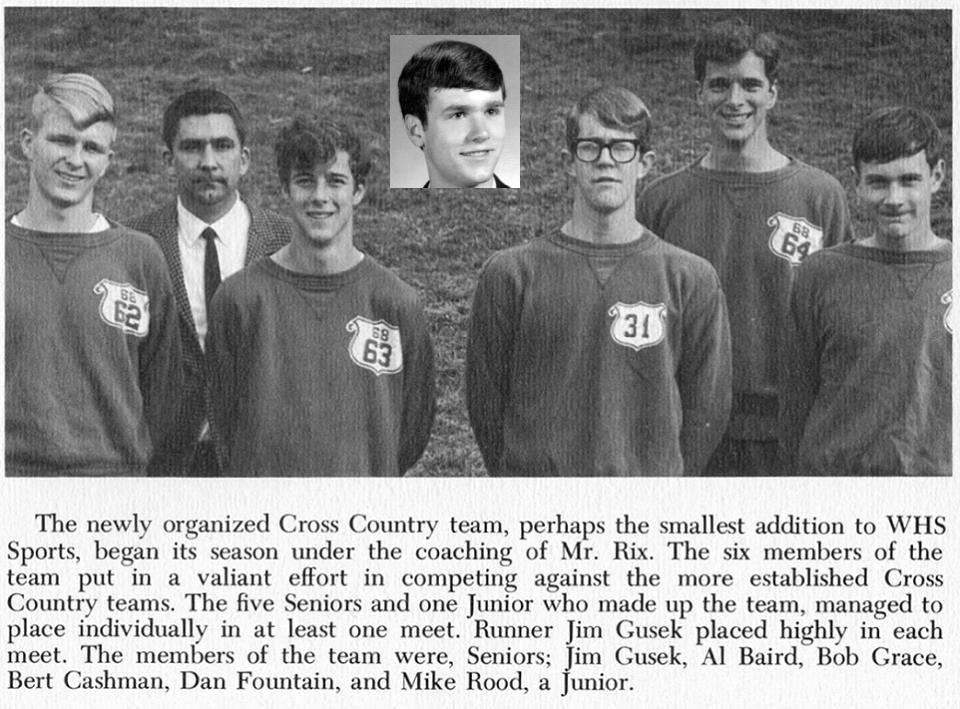
L-R [click to enlarge]: me, Coach Reign Rix, Jim Gusek, (Bob Grace), Dan Fountain, Bert Cashman, Mike Rood. Later: ZoomFest.
Later, I found out that WHS had no winter track team, so I cooked up some workouts for them/us, too. We were invited to run at a meet in Boston, and that's when I got busted.
The toughest part of moving away from Chelmsford was leaving Kathy behind. We talked on the phone and wrote letters, but it wasn't the same. So when I qualified for the Boston YMCA indoor track meet, we made plans. Confidential plans. Top-secret plans. Our parents wouldn't know anything. At the meet, a photographer from the Boston Herald Traveler was roaming around, taking lots of photos. When he noticed us smooching, he thought it would make a cute picture. We laughed, knowing that his editor wouldn't pick THAT photo from the hundreds he'd shot.
The next morning, after both sets of parents finished reading the Herald Traveler, we weren't laughing quite so much.

A few months later, Kathy and I split up. They say long-distance relationships never last. But I still have that bronze YMCA medal. And some wonderful friendships, from both schools, that are well past the 50-year mark.
Plus... the treasured memory of a not-so-secret kiss.


High School Daze 2: As Schools Match Wits.
The two pieces of the puzzle finally fit together - in the yearbook pic, I was mysteriously missing. But now, thanks to a screenshot of a screenshot by teammate William Sharpe and his dad, I have mysteriously reappeared. We were losers, but we were *handsome* losers. 😉
PBS, NEPM, Wikipedia, IMDb
L-R, T-B: Georgia Keefe, Arthur Newcomb / Rosemarie Fisher, James Lane, William Sharpe, Bruce Dewey, Deborah Baker // Bruce Dewey, William Sharpe, James Lane, me.

Labels: hb
High School Daze 1: Boys State Rebellion.
My lovely wife recently dug this out of a long-forgotten storage box...
Summer 1968: Town 4, Massachusetts Boys State www.maboysstate.org
Each high school in Massachusetts selects an unsuspecting junior to get a patriotic indoctrination in the U.S. electoral process from the American Legion. Chelmsford made the mistake of selecting me. The Boys Staters lived on the UMass-Amherst campus, and we were supposed to form town groups, elect town-level leaders, stage a couple of conventions (Republican and Democratic) and elect state-level candidates.
But I had a different idea. After organizing a rebellion, a bunch of us took over the convention hall and staged a third-party convention. We were nearly kicked out and sent back to our high schools in disgrace, but the coup got so much publicity that several of us received invitations to attend Harvard, instead. 😉 My family couldn't afford the tuition, unfortunately.
[click to enlarge]

Labels: hb
The Thirty-One Dollar Man.
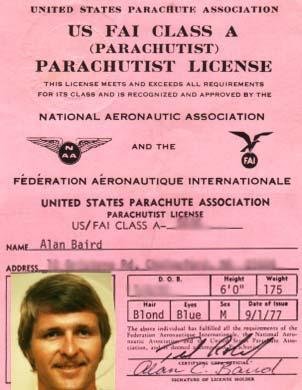 1975: The wind whipped my face, as I stood there in the drop zone. It wasn't the safest day for a skydiver with a round parachute, like mine. But I decided to jump anyway. Why? Because I'm stupid.
After a twenty-minute ride up to altitude, I climbed outside the airplane, and dangled off the wing strut. It was even windier out there. The plane's 60-mile-per-hour forward speed buffeted my body, but I hung on until my partner was sitting in the doorway. When he nodded and jumped, I let go and arched my back. The spread-eagle position kept me vertical for a few seconds, as my body burned off the forward speed of the airplane. Slowly, I started falling belly-to-earth.
We did a little relative work, or rather, HE did some relative work. I just kept my body in a hard arch, while he flew down to grab my wrists. But he had too much speed, and we began oscillating like a see-saw. First my feet went up towards the sky, then his. We both tried to correct the wild movements, by extending our feet at the appropriate moments. But nothing worked. We were both too new at this. So I pushed him off, and turned around to fly away. After a few seconds, I gave a warning wave and pulled the ripcord.
As my round chute inflated, I saw his ram-air chute unfold, a hundred yards away. He flew a few circles around me, laughing like a maniac: "Why don't you get a decent chute?" I flipped him the bird. He knew I couldn't afford it.
My Army-surplus round parachute had a cutout in the back, for stability and steering. In a normal descent, that cutout gave the canopy a forward speed of about 8 miles per hour. His expensive ram-air canopy, which looked like cross section from a swimming-pool air bed, could generate forward speeds from 0 up to 30 mph.
So I lined up my chute to face into the 25 mph wind. Subtracting the canopy's 8 mph forward speed, I was now scooting along at 17 mph. Backwards.
Plus, my standard rate of vertical descent was already 13 mph, given the design of my particular chute and my normal body weight. I suddenly regretted eating that sixth slice of pizza the previous night.
As I got closer to the ground, I realized that I was headed straight for a barbed-wire fence. So I turned the canopy around. Now I was whizzing along at wind speed PLUS canopy speed, instead of wind speed MINUS canopy speed. 33 mph, instead of 17 mph. And that was just the horizontal component. I was also dropping out of the sky vertically at my standard 13 mph. I thought, "This can't end well."
My brain kicked into overdrive, trying to compute the combined vertical/horizontal velocity. But as the ground rush intensified, the math got harder and harder to do. After the barbed-wire fence zoomed past underneath me, I instinctively turned the canopy around, to head into the wind again. The canopy dug in, and my body swung wide underneath it, much like a pendulum. The resulting forward swing of the pendulum canceled out the backward push of the wind, and I landed with very little horizontal speed at all. Easy squeezy.
My partner applauded, from 200 feet above: "Nice hook!" His chute was effortlessly holding steady against the wind, and he was coming down almost vertically. It was quite the contrast to my white-knuckle landing.
After repacking the chute, I decided to go again. Stupidity squared. This time, I chose to swan dive out the airplane door by myself. I had had enough of my partner's see-saw routine. So I practiced my free-fall spins: tilt both hands to the right, recover, tilt to the left, recover. Then somersaults: straighten my legs, tuck my hands and head, recover. Then rolls: reach to the side with one arm and one leg, recover. Easy squeezy.
Pop the ripcord, line up into the wind, no problem. But as I got closer to the ground, I noticed the wind speed had increased, during my ride up to altitude. The velocity situation was looking ugly. No fancy "hook" maneuvers were going to save me this time. At 100 feet above the ground, I went zipping past some horrified onlookers. I yelled "HELP!" Groundrushgroundrushohcrapohcrap. Darkness.
They tell me that I was about 20 feet above the ground when a sudden gust of wind blew my chute backwards. My body, of course, responded less dramatically to the wind gust, so a slightly different pendulum effect was created this time. Have you ever wanted to climb to the top of a double-decker bus careening through the streets of London at 40 or 50 mph, and jump off? Facing backwards?
Long story short: I was smashed into the ground by this pendulum. Then my unconscious body was dragged 200 feet by my still-inflated parachute. Luckily, a nice woman had sprinted to my aid, when I yelled "HELP!" Somehow, she caught the runaway chute and deflated it. She waited for me to regain consciousness, then asked, "What hurts?" She drove me to the local hospital and waited while my elbow was X-rayed. She commiserated with me, when the doctor said the anesthesiologists were on strike, and I couldn't get the operation I needed. She drove me back to my car, after the doctor packed my shattered left arm into a temporary plaster cast. Then she waited patiently while I tried to figure out if I could drive my stick-shift car 50 miles back home, across the San Francisco Bay. I vowed to return her kindness, somehow.
The trip turned into a blur of pain, so I stopped at a liquor store for a fifth of tequila. The bottle was nearly empty when I arrived home. It helped quiet the screaming elbow, but it only intensified the agony of the concussion.
Over the next few days, I found out that my elbow needed an immediate operation, or it would end up f*cked. I'm pretty sure that was the medical term they used: f*cked.
And since the anesthesiologists were on strike, the only place that could operate on me was the teaching hospital at the University of California, San Francisco. They had "baby" anesthesiologists: anesthesiologists in training. They also had "baby" surgeons. My baby surgeon told me that he had never done this operation before, but not to worry, because the surgery would be supervised by his teacher, a "real" surgeon. I wasn't mollified, but what could I do? If I didn't let him operate, my elbow would end up f*cked. Medically f*cked.
After the surgery, he told me an interesting story: when they handed him the 6-inch Leibniz screw that was supposed to knit my shattered elbow back together, it was twisted. So he sent it back to the supply room, and asked for another. When the second screw arrived, it was also twisted. That's when his supervising surgeon picked up the screw and bent it back and forth. It turns out that Leibniz screws are designed to have great strength in the long direction, while offering great flexibility in the side-to-side direction. Since the outside forearm bone, the ulna, is slightly curved, the screw needs to curve with it. When the baby surgeon finished telling this story, he laughed. He thought it was funny as hell. Me? Not so much.
So I went home to heal. After several weeks, the baby surgeon took off my plaster cast. I was shocked at how much my arm had shrunken. He said I would probably regain only 75% of the full range of motion. But Macho Stupido hopped on his motorcycle, and started riding. After a month, the arm looked and moved normally.
A few months later, I mustered some courage and drove back out to the drop zone. I found the nice woman who had been so kind to me on the day my arm was broken, and I offered to buy her a couple of jumps. She seemed genuinely touched, and invited me to come along with her and her boyfriend. They knew a lot more about relative work than my old partner. When they flew down to grab my wrists, there was no see-saw oscillation. And right there, at 6,000 feet and terminal velocity (120 mph), the nice woman kissed me. It was my first kiss in free fall.
Even to this day, if you place your palm on my left elbow, you will feel an icy-cold spot. And I still have the itemized hospital bill that lists $31.00 for a Leibniz screw. [Scar #3]
Related: Vertical wind tunnel and Vertical wind tunnel tips and Brown-Air Express.
Cone of Concussion. Independence Day is coming! I wrote this nonfiction essay in the summer of 2003, and Inkburns (the 18th best place to get published online) bought the first rights in December of that year:
 The ten minutes before showtime were surreal: seven of us stood between the double line of mortar tubes, lost in our own thoughts, trying not to stare at each other. Everyone was decked out in safety goggles, blast helmets and flame-retardant Nomex. After sweating all day in the hot sun, we had finally erected a fearsome arsenal of rack-mounted guns, designed to hurl fireworks shells hundreds of feet into the sky. Our audience members were safely ensconced two football fields away, sitting more-or-less comfortably in wooden bleachers and listening to a group of Beach Boys imitators. But we were locked inside a no-man's-land behind two separate sets of chain-link fence, patrolled by a squad of police and firefighters.
For me, this was a dream come true. I was finally getting a chance to step up to the big time of professional pyrotechnics, from the sparklers, roman candles and cherry bombs of my youth.
 For Anikó, it was something else entirely, and I was still not sure I completely understood why my new Hungarian wife was standing there between the racks, gazing off into space through her industrial safety glasses. Many years ago, a pressure cooker exploded in Anikó's kitchen, and she was nearly killed by the detonation. After spending several weeks in the hospital, her arms were still scarred... a testament to her reflex for protecting the eyes from such a powerful blast. However, her instinctive efforts had not been completely successful, and for several days the doctors were unable to determine if she would ever see again. Today, more than a decade later, she still cannot bear the pain of going outdoors--even in cloudy weather--unless her eyes are protected by dark glasses.
Suddenly, that surfing music stopped, and the distant crowd began a countdown. Our lead operator lit his road flare, preparing to send up the opening barrage of product. His spotter stood close behind, lightly resting a hand on his shoulder. The first 3-inch shells were almost deafening, even though we all wore earplugs. I glanced skyward distractedly and thought, "Wow. I've never seen these babies explode directly overhead."
To gear up for tonight's performance, we had watched several homemade videos of previous years' shows. The process of hand-lighting fireworks looks fairly innocuous on tape, but the cameraman had been restricted to a safe distance, so we were completely unprepared for the enormous amounts of flaming debris which now rained down on our lead operator and his spotter. When engaged in the disorienting task of shooting up aerial bombs, the spotter's job is crucial: he brushes you (and himself) off after each shell, and reminds you, by pushing down on your shoulder, to stay below the cone of concussion, which can easily knock you flat onto the ground.
 Okay, the first three racks of 3-inchers and 4-inchers were spent, and our lead operator passed the flare to his spotter, like a flaming baton. Anikó raced over to take her place as the new spotter, and she was forced to brush off embers even more energetically, as the first 5-inchers went up. Things became pretty darn loud for a while, but by the time Anikó received the baton, some smaller 3-inch guns were next in the firing line. During our runthrough, she had asked me to be her spotter, just in case those old memories of the pressure cooker proved to be too overwhelming. So I gently placed my hand on her shoulder, ready to accept the baton at the first sign of skittishness.
After her first shell "whumped" out of its gun and the hot wave of backwash hit our faces, I could feel a bit of shaking through her Nomex jacket, so I quickly brushed the embers off both of us and squeezed her shoulder encouragingly. To my surprise, she stepped right back in and lit the second round. What a trouper. By the time we reached the end of the rack, eight shells later, she seemed almost at home in this living hell of thunderous explosions and burning rain.
But when I looked over my shoulder at the next rack, three huge mortar barrels stared back at me. 6-inchers. Holy cow. Anikó was unknowingly scheduled to ignite half of our team's largest shells.
 She obviously hadn't planned on this, and I could see the fear behind her safety goggles as she glanced at me. I patted her shoulder, and prepared to take the baton. But then she stepped right back in, to light the next quickmatch. When that huge shell went up, its heavily-braced wooden rack jumped clean off the ground. I was busier than ever, brushing away a veritable blizzard of flaming embers. One of them burned through my sneaker and seared the back of my foot, but I was too busy watching Anikó. She looked around, hesitated... and then stepped in again. Nothing was gonna stop this lady now.
Later, she was given the honor of lighting off our set piece - an American flag in the form of fireworks. Piece of cake.
During the drive home, I asked why she had agreed to participate. After all, I was the crazy guy who wanted to fulfill his childhood dream of 'blowing things up,' while she was just a nervous woman who often jumped at the distant backfire of a car.
She replied simply, "A wife should share her husband's experiences, no?"
Update: now in the facebookworm book (p.32).
Loose Lips Sink Ships. I wrote this flash memoir for Identity Theory, and they published it on January 15, 2003:
The classified ad in San Francisco's Bay Guardian was straight out of a doper's dream: Marijuana Research Subjects Wanted. Sure, why not?! In those days—late 1975—it seemed surprising that the U.S. government was still trying to figure out the physiological effects of cannabis, but if they were willing to pay folks to smoke their Mississippi-grown weed, I certainly didn't want to be left out.
 Besides, the ongoing studies were taking place in Langley Porter Neuropsychiatric Institute at the University of California SF, a place made legendary by The Electric Kool-Aid Acid Test, Tom Wolfe's 1967 opus. Several passages in his book documented the adventures of fellow writer Ken Kesey, who spent a significant amount of time in Langley Porter, gobbling down the government's LSD. Ken was one of our generation's heroes, and not just for writing One Flew Over the Cuckoo's Nest.
My screening session consisted of being locked inside a small airtight room, while an erstwhile grad student sat in a nearby chair, to ensure that I practiced good smoking technique with one of the program's fat, U.S. Prime, machine-rolled doobies. He had nothing to do except watch me, and I had nothing to do except smoke, so we struck up a dialogue which gradually became quite fascinating. As the drug gained traction, I kept forgetting where we were, and often attempted to pass the joint over to him, out of simple courtesy. Since he was obliged to enforce the experiment's protocol, he always turned down my proffered toke, but a contact high was unavoidable in that tiny room, and the longing in his eyes grew more and more pronounced.
For insurance reasons, the experiment itself required a commitment to living inside Langley Porter's supervised hospital psych ward, so I secured a 30-day leave of absence from my day job. Getting wasted was dirty work, but somebody had to do it. During the first week, the four of us enrolled in the research study were given placebo pills every six hours, around the clock. We weren't supposed to know they were fake, but nobody was getting off, so we shrugged our shoulders and tried to settle into the mental facility's daily routine: screams in the night, blood on the bathroom walls from failed suicide attempts, zombie-like patients who wondered why we chose to live among them.
 Then there were the daily 14-page physiological self-evaluations, which included hundreds of questions like: "Is your mouth wet or dry? Do your feet feel cold or warm? Are your lips loose or tight?" It took nearly an hour to diligently complete the entire form, and the question about lips came near the end, when everything began to seem quite absurd, so I always added these words: Loose Lips Sink Ships. I figured this reference to a common WWII security slogan, warning citizens against revealing unnecessary details to strangers, might amuse the poor graduate students who were forced to process these godawful forms. But a few days later, one of them hesitantly pulled me aside, whispering, "Is this some kind of code?"
Following a week of baseline physical tests, the placebo pills were suddenly replaced with real THC. Yaaay! I started to relax, and interact with the non-study patients. They, in turn, began to seem less disturbed, less strange, less like... The Other. I even talked to the 14-year-old boy who mutely followed me around the pool table, like a puppy dog. After a couple of weeks, we were old buddies, even though he never said anything in return. I slowly became aware of the patients he liked and disliked, from subtle changes in his body language, and he began to smile at my lame jokes. During the fourth week, his father visited - and spent an hour berating him, inside his room. I overheard the monologue through an open door, and winced.
Then the father came to visit me, beside the pool table: "He hasn't smiled in three years! How did you do it?"
The nurses must have said something. I was caught off-guard, but managed to blurt out, "I dunno. I just try to listen to him."
"But he never speaks!"
"I know."
***
Update - pay stub. When the U.S. government offered me $725 to be a test subject in "Clinical Studies of Tolerance to Marijuana," I was proud and honored to serve my country:

Nobody likes a smarta**. After rereading one of my old stories (first published on 7Nov2003 by Opium Magazine and reproduced below), I dug this eMail exchange out of the archives:
Date: Mon, 15 Nov 1999 06:59
From: Alan C. Baird
To: Merriam-Webster
Is it my imagination, or does your dictionary contain a misspelling (pointtillist=pointillist)?
Date: Mon, 22 Nov 1999 16:02
From: Maria Sansalone, Merriam-Webster Editorial Department
To: Alan C. Baird
You know what's even worse Alan? It's been in our print dictionary this way since at least 1981!
***
 Buzz Words [estimated reading time: 1:45]
At the ripe old age of thirteen, Buzz earned a trip to the 1964 National Spelling Bee, after winning a series of local competitions. However, he bombed out on the second word ("abbot") because his school bus stopped at Abbott Street every day. Even though his left brain knew the proper spelling, his stubborn right brain insisted on calling up images of that treacherous street sign, standing a mere two feet outside the safety-glass bus window.
So our vanquished hero spent the remainder of the competition sitting in the audience, writing down every word and torturing himself with dreams of What Might Have Been. He'd even worked out a complex algorithm to predict which words would have been "his," and spelled each one of them correctly: "vicissitude," "diastema," and especially the dreaded "myxovirus." By his reckoning, he should have won the whole shootin' match . . . but Abbott Street had wrecked his budding career as WordBoy.
The next year, he entered local history books by becoming the first area youngster to win two Washington trips in a row. This time, he was relaxed, joking with fellow contestants while finishing 14th in the country, stumped only by "gneiss." He deemed the word to be an honorable Waterloo, even though it didn't sound that way (pronounced "nice"). But most importantly, he was delighted with his 1965 results, the trip, and life in general. Every few years, the regional newspaper still publishes a huge picture of him during the spring, in their annual Spelling Season Shrine.
 Could he have won the national competition in that first year? Maybe. But if he'd survived 1964's second round, the same words would have been doled out to different contestants, during later rounds. Words that were spelled easily, in his "abbott" universe, might have been misspelled, in the alternative "abbot" scheme of things. For example, his fancy algorithm couldn't really predict if little Susie would be able to deal with "escharotic" in AbbotWorld, when she was only required to spell "escapist" in AbbottWorld. Thus, Buzz's subsequent word list would end up slightly altered--which means he certainly *didn't* know it all.
Although he often acted that way.
Still does, as his friends will eagerly tell you.
However, sweet revenge was exacted from his old nemesis (Merriam-Webster) during the late fall of 1999, when he pointed out "pointtillist" . . . a misspelling which had appeared in their dictionaries for nearly two decades.
As you might guess, he's still bragging about that.
***


June, 1964: Dad/Mom/Nerd/Rep. Brad Morse (R-MA)/Flag.
The Lowell Sun (MA) newspaper used to sponsor an annual spelling competition among the local schools.
For a couple of years in the mid-Sixties, I hogged the competition limelight.
The Sun wasted a ton of ink on me, and sent me to the National Spelling Bee in Washington, DC. Twice.
They bought me clothes, gave me cash, flew Mom and me to DC, and put us up in a 5-star hotel for a week.
They really made me feel like a Big-Shot Celebrity.
While I was in Our Nation's Capital, I just wanted to study. What a nerd.
But the National Spelling Bee organization had set up a bunch of tours for us nerds.
And the Sun's DC correspondent had the thankless task of following me around, snapping pictures and writing puff pieces.
 A staggering number of those pictures and puff pieces were published on the Sun's front page.
So I guess the local congressman got wind of a possible photo op, and decided to horn in.
But he was also kind enough to give me a tour and introduce me to many famous lawmakers.
He even pulled some strings and got the Architect of the Capitol to send me that flag.
He really made me feel like a Big-Shot Celebrity.
Then Mister Big-Shot Celebrity started competing in the National Spelling Bee, and fell flat on his face...
But that was 1964. 1965 went a little smoother (see below).
Unabridged.
In 1964, the spelling bee at Chelmsford [MA] Junior High School was televised via CCTV, which meant that everybody knew who Li'l 13-year-old Alan was. It seemed like they almost expected me to win a trip to Washington in the Lowell Sun regional spelling bee. And I did.
But when the 1965 CJHS bee rolled around, it was a much more intimate affair. I had already received WAY too much press coverage, and I think they wanted to keep it from going to my head.
Too late. 😉
So the bee was held in the school library, with no CCTV. When we got down to the last four spellers, I received the word "sanitarium." I spelled it "sanatarium," and was heartbroken after they said it was wrong. The bee continued without me, so I wandered over to the huge unabridged Webster's dictionary, sitting on a lectern next to the wall. When I noticed that "sanatarium" was an acceptable variant, I interrupted the bee, and they graciously reinstated me. Nobody else had been eliminated, so things just continued along as if nothing had happened.
Then I received the word "weiner," which I spelled "wiener." When they called me out, I made a beeline (sorry) for the Webster's. Sure enough, another alternate spelling. After that, the other kids pretty much gave up.
Poor bastards. 😉

But First, A Flashback To 1963.
I got my initial taste of competitive spelling in New York City, winning the class, school and district bees to make it into the 1963 Citywide Spelling Championship. NYC was the only regional contest which sent two kids to the National Spelling Bee, and the NYC co-champions that year were Phyllis Kaplan (#19) and David Leyenson (#26). It was Phyllis' first trip to Washington, but sixth-grader David was a powerhouse speller, going to DC for the second year in a row. Naftali Lewin (#25) and I (#3) didn't know each other back then, but we are both currently members of a NSB group on Facebook. Naftali recently told me that he was one of the final five in the 1964 NYC contest, along with Phyllis and David and two other spellers. He eventually became a co-champ in the 1964 competition, beating both 1963 co-champs in what he jokingly calls one of the "greatest upsets in NYC Spelling Bee history"! 😉

Flying to Washington, 1965.
The photo below first appeared in The Lowell Sun (MA) on June 7, 1965. This scan is from the second time it was published (on April 23, 1970): "Alan Baird, the only scholar to win [the Sun's spelling bee] in two consecutive years, boards a plane to Washington, flanked by his mother and a stewardess. Baird was area champ from Chelmsford in 1964 and 1965."
I still think that stewardess was hot for me. See her checking me out, from the corner of her eye?

Washington Party.
June 7, 1965: Peter Treadwell (C) and I (L) were classmates at Hermon (ME) Elementary School in the fourth grade (1961), before my family moved away to New York City and then to Chelmsford, Massachusetts. Peter and I had a reunion of sorts at the 1965 National Spelling Bee, after he won the Maine Spelling Bee. We were catching up on old times at the opening-night party, when Peter's photographer grabbed Michael Gifford (R), from Guam, and took a picture of the three of us. "Peter Treadwell, center, of Hermon, Maine's 1965 Spelling Champion, met National Spelling Bee contestants from as near as Massachusetts and as far away as Guam during six-day visit to Washington last June."
[tap to enlarge]

First Day of Competition.
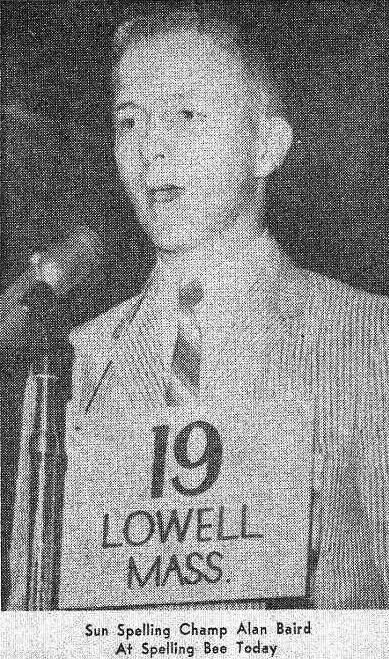
June 9, 1965, The Lowell Sun (MA): "Sun Spelling Champ Alan Baird At Spelling Bee Today." That was the year I actually lasted into the second day of the National Spelling Bee, eventually placing 14th in the country.
That was also the year I thought seersucker jackets were the height of fashion.
UPDATE: Ben Bernanke & Me.
Have I told you my Ben Bernanke story yet? (He was the Fed chairman from 2006 to 2014. Some say that made him the most powerful man in the world.)
I already told you the story? OK, shut up and listen anyway. 😉
A 2009 Time magazine article (LATER: CBS) mentioned that he competed in the National Spelling Bee when he was a kid. So, after going through the speller lists from the two years I was in the Bee, I discovered that we sat next to each other in 1965 (he's wearing #18, representing Anderson [Dillon] SC, and I'm wearing #19, representing Lowell [Chelmsford] MA). It looks like he's leaning over to give me financial advice.
I misspelled "gneiss" that year, to finish 14th in the country. Ben tripped on "edelweiss" and finished 26th. I don't have a song memorializing my losing word, but Ben does. 😉
LATER: oh yeah, Ben also won a Nobel. What the h*ll have I been doing with my life?! [tap to enlarge]

Spelling Bee dirt.

I recently heard the shocking story of Larry Fishman (#45), from Maryland, who sat two rows behind me (#19) and placed eleventh.
Larry murdered his father (obit) and shot his mother about 15 years after the '65 Spelling Bee, according to the FBI.
So I guess Larry wanted to get famous a lot sooner than Ben did...
Facebook fan pages: 1964 ~ 1965
Facebook group: National Spelling Bee Contestants, 1964 & 1965
UPDATE - 100th anniversary rosters: 1964 ~ 1965 ~ psych
(Tap "hb15" label below to see this "hb" posting #15 and 3 earlier "hb" articles.)


